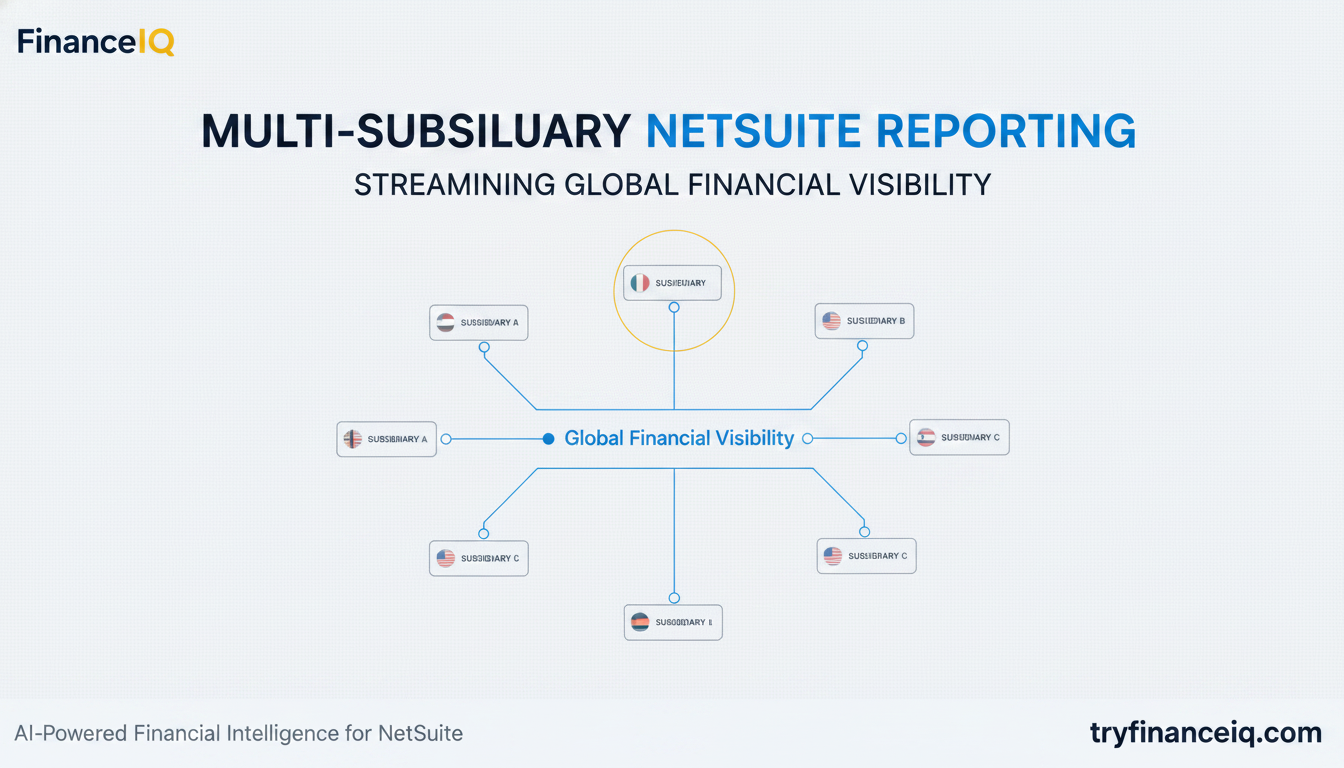
Multi-Subsidiary NetSuite Reporting: Overcoming Consolidation Challenges for Global Finance Teams
Managing consolidated financial statements and intercompany eliminations in NetSuite OneWorld can be complex for global finance teams. Learn how to navigate common multi-entity reporting limitations and streamline cross-subsidiary visibility.
- NetSuite
- Financial Reporting
- Consolidation
- Multi-Subsidiary
- OneWorld
- Intercompany Eliminations
- Multi-Currency
- CFO Insights
- Financial Planning & Analysis
As businesses scale, expanding into new markets or acquiring new entities, the complexity of financial reporting grows exponentially. For NetSuite users, this often means leveraging NetSuite OneWorld for multi-subsidiary management. While powerful, navigating consolidated financial statements, intercompany eliminations, and multi-currency reporting within OneWorld presents distinct challenges.
Finance leaders—CFOs, controllers, and FP&A professionals—are tasked with providing accurate, timely, and digestible insights across diverse operations. Yet, the traditional workflows for multi-entity reporting in NetSuite can be slow, rigid, and resource-intensive, often leading to a reliance on manual spreadsheet work outside the ERP. This guide explores the architecture of NetSuite's multi-subsidiary reporting, its strengths and limitations, best practices for controllers, and how modern tools can streamline the entire process.
The Anatomy of Multi-Subsidiary Financial Reporting in NetSuite OneWorld
NetSuite OneWorld is designed to support companies with multiple legal entities, business units, or international operations within a single instance. This architecture centralizes data while allowing for localized operations and reporting. Understanding its components is key to mastering consolidated views.
NetSuite OneWorld Architecture and Subsidiary Hierarchies
At the core of NetSuite multi-subsidiary reporting is the subsidiary hierarchy. Companies can establish a tree-like structure where a parent company sits at the top, with various child subsidiaries beneath it. This structure can be several layers deep, reflecting complex organizational charts and enabling roll-up reporting from the lowest level to the consolidated group level.
Each subsidiary can have its own base currency, tax nexus, statutory reporting requirements, and even its own chart of accounts (though standardizing is a best practice). This setup allows for granular control over local operations while facilitating a unified view for corporate finance. Financial transactions are recorded at the subsidiary level, and OneWorld aggregates these up the hierarchy for consolidated reporting.
Intercompany Eliminations and Currency Revaluation
When subsidiaries transact with each other (e.g., one subsidiary sells goods to another), these are known as intercompany transactions. For consolidated financial statements to accurately reflect the economic activity of the group as a single entity, these intercompany balances and transactions must be eliminated. NetSuite provides mechanisms to identify and eliminate these entries, typically through specific intercompany accounts and sometimes through an Elimination Subsidiary.
Elimination Subsidiaries are non-posting subsidiaries used solely to record elimination journal entries. By posting matching entries in the elimination subsidiary, companies can remove the effects of intercompany transactions without impacting the individual subsidiary's local financial statements. This is critical for presenting a true picture of the consolidated entity's performance and position.
Multi-currency accounting is another critical aspect. When subsidiaries operate in different base currencies, NetSuite automatically revalues foreign currency balances to the parent subsidiary's base currency using predefined exchange rate types (e.g., current rate for balance sheet, average rate for P&L). This process generates unrealized gains or losses from currency fluctuations and manages cumulative translation adjustments (CTA) on the consolidated balance sheet.
Generating Consolidated Financial Statements with Financial Report Builder
NetSuite's Financial Report Builder is the primary tool for creating consolidated financial statements, including the income statement (P&L), balance sheet, and cash flow statement. This builder allows users to customize report layouts, apply filters by subsidiary and other Dimensions (like department, class, location), and define how accounts are presented. Users can select a parent subsidiary, and the system automatically rolls up data from all child subsidiaries beneath it, applying currency translation and intercompany eliminations as configured.
While powerful for customization, the Financial Report Builder requires careful setup to ensure accuracy. Users must define column layouts, apply specific reporting periods, and confirm that intercompany elimination rules are correctly applied to present a clear, consolidated view. The reports can be generated on demand, reflecting live data from the NetSuite instance.
Strengths of NetSuite for Multi-Entity Financial Reporting
NetSuite OneWorld offers several significant advantages for companies navigating multi-entity financial reporting, particularly in its ability to centralize and automate many complex processes.
Automated Transaction Roll-ups
One of NetSuite's core strengths is its capability to automatically roll up transaction-level data from all child subsidiaries to the parent. This ensures that when a consolidated report is run, all underlying local transactions are accurately aggregated. This automation significantly reduces the manual effort and potential for errors associated with compiling data from disparate systems or individual subsidiary ledgers.
Robust Multi-Currency Accounting
NetSuite provides comprehensive multi-currency support, handling transactions in various currencies, maintaining exchange rate tables, and performing automated revaluation at month-end. This functionality is crucial for global operations, ensuring that financial statements accurately reflect the impact of currency fluctuations on foreign subsidiary assets, liabilities, revenues, and expenses. The system manages both realized and unrealized gains/losses from currency movements, streamlining a complex aspect of global financial reporting.
Automated Intercompany Elimination Processing
When configured correctly, NetSuite can automate a significant portion of the intercompany elimination process. By tagging transactions as intercompany and setting up appropriate elimination rules, the system can generate the necessary journal entries to remove the effects of intercompany sales, purchases, and loan balances for consolidated reporting. This capability is a major time-saver, reducing the need for manual identification and adjustment of these entries, which are often prone to errors in spreadsheet-based processes.
Comprehensive Audit Trails Across Entities
Every transaction in NetSuite carries a robust audit trail, regardless of the subsidiary it originates from. This means that a finance professional can drill down from a consolidated balance in a report all the way to the individual transaction at the subsidiary level. This transparency is invaluable for auditors and internal controls, providing confidence in the accuracy of consolidated financial statements and simplifying the reconciliation process across multiple entities.
Common Pain Points and Limitations in NetSuite Subsidiary Consolidation
Despite its strengths, NetSuite OneWorld reporting can present significant challenges for finance teams, especially as the number of subsidiaries or the complexity of operations grows. These limitations often lead to inefficiencies and frustration for those tasked with producing timely consolidated reports.
Performance Bottlenecks with Large Subsidiary Structures
One of the most frequently cited challenges with NetSuite subsidiary consolidation performance is the slowdown experienced when running consolidated reports across a large number of child subsidiaries. As the volume of data and the depth of the hierarchy increase, the system can take a considerable amount of time to process and render these reports. This can significantly delay the month-end close process and hinder finance teams from providing timely insights to executives. The computational overhead for complex currency revaluations and intercompany eliminations contributes to these performance issues.
Rigidity in Custom Elimination Entries and Adjustments
While NetSuite offers automated intercompany elimination rules, finance teams often encounter scenarios requiring highly specific or manual elimination adjustments that don't fit neatly into standard configurations. Implementing these custom rules or making ad-hoc adjustments can be cumbersome within NetSuite's native framework. This rigidity can force controllers to perform critical elimination entries outside the system, typically in spreadsheets, and then manually re-key or adjust consolidated figures, introducing risks of error and inconsistency.
Challenges with Historical Exchange Rates and Cumulative Translation Adjustment (CTA)
Managing NetSuite multi currency reporting across entities, especially when dealing with historical exchange rates for fixed assets or specific equity accounts, can be complex. Tracking cumulative translation adjustment (CTA) on the consolidated balance sheet, and understanding its movements, often requires deep knowledge of NetSuite's currency translation methodology. Adjusting historical rates or validating CTA calculations can be less intuitive than desired, leading to reconciliation variances and increased audit scrutiny.
Lack of Flexible Executive Dashboards for Multi-Entity Views
While NetSuite offers dashboards, creating highly flexible, executive-level netsuite multi entity financial reporting dashboards that combine key metrics across multiple subsidiaries without extensive customization or SuiteAnalytics Workbook development is a common pain point. CFOs and VPs of Finance often need to compare performance side-by-side, drill down into specific entities, or visualize trends across the entire group. Achieving this level of dynamic, consolidated visibility natively often requires significant investment in custom reporting or relies on static, exported reports.
Best Practices for Managing NetSuite Intercompany Eliminations and Multi-Currency Reporting
Effective management of intercompany transactions and multi-currency operations is crucial for accurate consolidated financial statements. Adhering to best practices within NetSuite can mitigate many of the common challenges.
Streamlining Intercompany Transactions and Matching
To ensure smooth intercompany eliminations, it is essential to standardize how intercompany transactions are recorded across all subsidiaries. This includes using dedicated intercompany receivable and payable accounts, consistent department or class tagging, and clear policies for intercompany invoicing and payment. Regularly reconciling these intercompany accounts is paramount. Automated matching features within NetSuite can help identify discrepancies, but a strong process for investigating and resolving unmatched intercompany balances is critical before consolidation. Utilizing an Elimination Subsidiary specifically for recording elimination journal entries, separate from transactional subsidiaries, helps keep the general ledger clean and transparent.
Navigating Currency Fluctuations and Revaluation
For NetSuite multi currency reporting, establish clear policies for managing exchange rates. NetSuite allows for different rate types (e.g., historical, average, current). Ensure these are consistently applied across the organization. Regularly review and update exchange rates within NetSuite to reflect market conditions. Pay close attention to the impact of currency revaluation on financial statements, particularly how it affects unrealized gains and losses. For the consolidated balance sheet, understand how cumulative translation adjustment (CTA) is calculated and where it resides in equity. Document your currency translation policies thoroughly to ensure consistency and facilitate audit reviews.
FinanceIQ: Streamlining NetSuite Multi-Subsidiary Reporting and Consolidation
The inherent challenges in NetSuite subsidiary consolidation performance and the desire for more flexible, executive-ready netsuite multi entity financial reporting often lead finance teams to seek specialized solutions. FinanceIQ is built specifically to address these pain points by connecting natively to NetSuite, transforming raw ERP data into actionable insights without the performance lag or manual workarounds.
FinanceIQ eliminates the performance bottlenecks often experienced when running NetSuite consolidated financial statements. It provides live, instant cross-subsidiary consolidation, allowing finance teams to access clean multi-entity comparative views and roll-ups without the delays associated with native NetSuite reports. This means real-time visibility into the performance of your entire global enterprise, or any combination of subsidiaries, at your fingertips. You can slice and filter financial data by any NetSuite Dimension—department, class, location, and subsidiary—in a unified, intuitive interface, offering unparalleled flexibility compared to traditional Financial Report Builder constraints.
When finance leaders need to quickly understand consolidated performance, waiting for reports to render is not an option. This is precisely where FinanceIQ excels. Below, we see a FinanceIQ Board that consolidates key profitability and liquidity metrics across an entire instance, providing immediate insights and period-over-period comparisons. This level of consolidated, dynamic visibility directly addresses the lack of flexible executive dashboards often cited as a limitation in native NetSuite reporting.
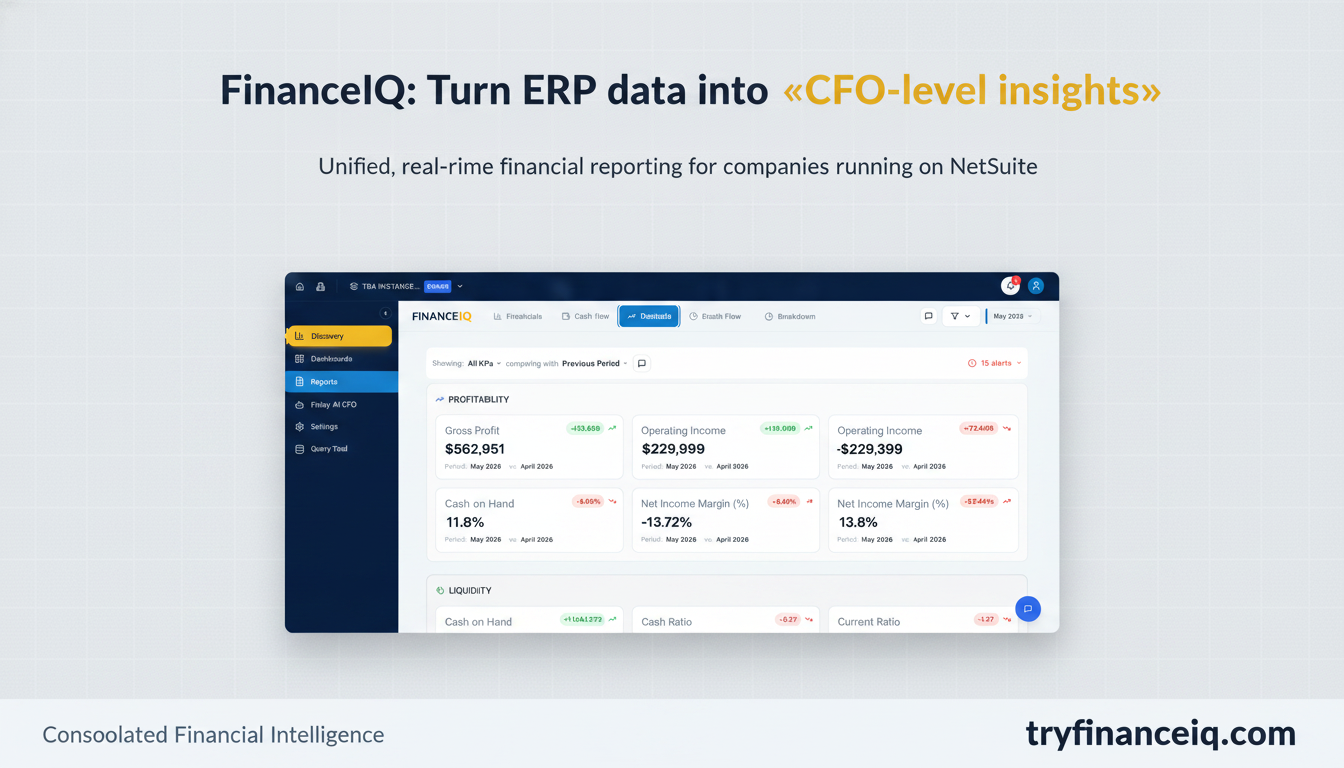
Furthermore, FinanceIQ simplifies the process of creating executive-ready Reports. These block-based management and board reports combine narrative text, charts, tables, and metrics, making it easy to assemble comprehensive packages for diverse stakeholders. With PDF export functionality and shareable links, these reports can be easily distributed to cross-border executive teams, offering a consistent and professional view of the consolidated financials without requiring direct NetSuite access. This solves the challenge of distributing multi-entity performance reviews to stakeholders who don't log into NetSuite.
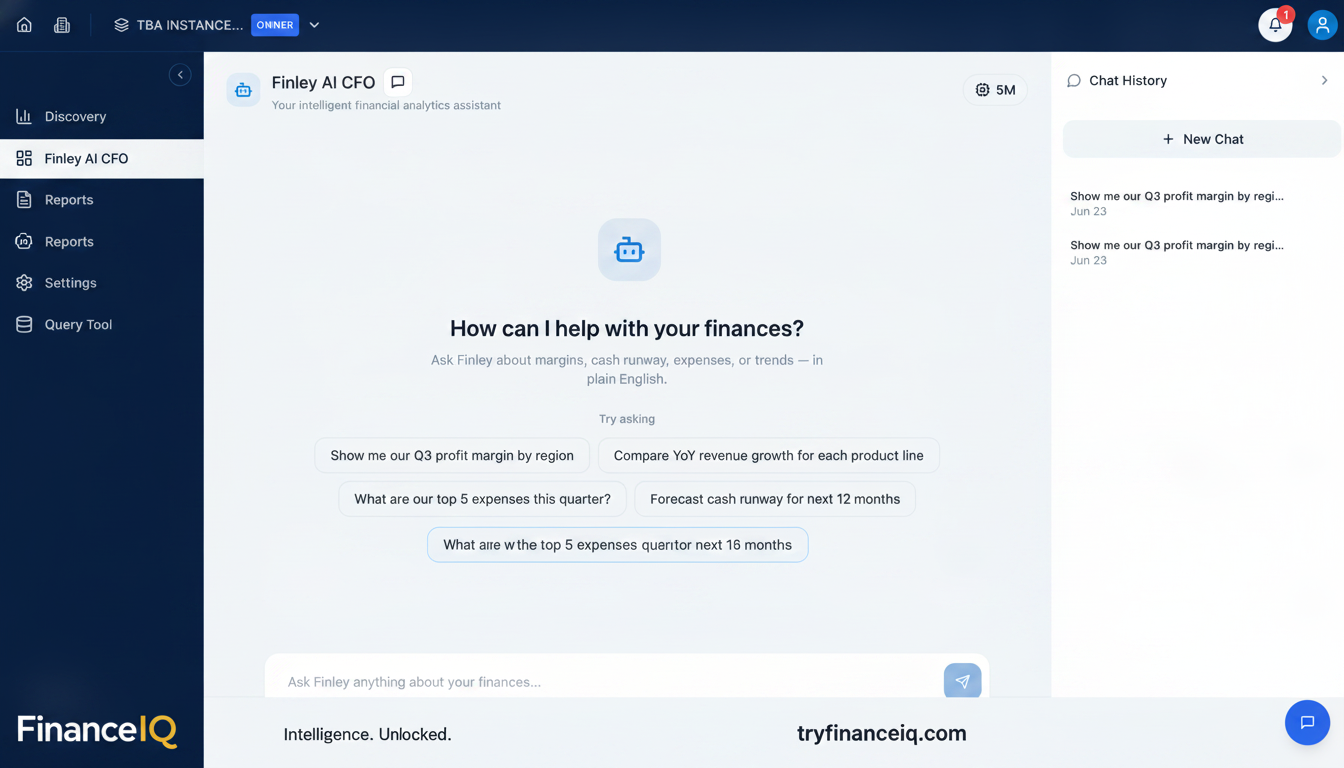
For specific, complex questions about your netsuite global financial reporting, FinanceIQ introduces Finley, the AI financial assistant. Here, we see Finley in action, demonstrating how it provides grounded financial insight directly from your live NetSuite data. You can ask Finley questions like, “what drove the variance in our European subsidiary last month?” or “compare gross profit margin across all subsidiaries for the last quarter,” making it particularly useful for quickly diagnosing issues or trends within specific entities without needing to manually run multiple detailed reports.
Multi-Entity Reporting Hygiene: Five Rules for NetSuite Controllers
Maintaining the integrity and efficiency of netsuite reporting across multiple books requires disciplined practices from the controller's office. Adopting these rules can significantly reduce errors and streamline the consolidation process.
1. Standardized Chart of Accounts Across Subsidiaries
While NetSuite OneWorld allows for subsidiary-specific charts of accounts, a standardized chart of accounts across all subsidiaries, especially for key revenue and expense categories, is a foundational best practice. This consistency greatly simplifies consolidated reporting, reduces mapping complexities, and enhances the comparability of financial performance across entities. Deviations should be minimized and well-documented.
2. Strict Monthly Close Timelines for Foreign Entities
The month-end close process for foreign subsidiaries must be carefully coordinated with the parent company's timeline. Establishing and strictly adhering to firm deadlines for submitting trial balances, completing local adjustments, and finalizing intercompany reconciliations is critical. Delays in even one subsidiary can hold up the entire netsuite subsidiary consolidation process, impacting the timeliness of consolidated financial statements.
3. Regularly Audit Intercompany Matching Accounts
Intercompany accounts are a frequent source of reconciliation variances. Controllers should implement a routine audit process for all intercompany receivable and payable accounts. This involves not only reconciling balances but also investigating the underlying transactions to identify and resolve any mismatches or untagged intercompany entries promptly. Proactive reconciliation prevents significant headaches at consolidation time.
4. Documented Currency Revaluation Policies
Clearly document the company's policies for currency revaluation, including the exchange rate sources, frequency of updates, and the treatment of specific accounts (e.g., historical rates for fixed assets). This documentation ensures consistency, facilitates training for new team members, and provides a clear reference point during audits, especially concerning cumulative translation adjustment (CTA) calculations and foreign currency gains/losses.
5. Clear Ownership for Elimination Journal Entries
Assign clear ownership for the creation, review, and posting of elimination journal entries, whether these are manual or system-generated. This ensures accountability and expertise in managing a critical aspect of netsuite intercompany eliminations. The owner should be responsible for verifying that all intercompany balances and transactions have been appropriately eliminated, ensuring the consolidated figures are accurate.
Multi-Subsidiary NetSuite Reporting FAQ
Why are my NetSuite consolidated reports running so slowly?
NetSuite consolidated reports can run slowly due to several factors. These often include the sheer volume of transaction data across many child subsidiaries, complex intercompany elimination rules, extensive currency revaluations, and highly customized report layouts in the Financial Report Builder. Each layer of complexity increases the processing time required for NetSuite to aggregate and translate all the data. Additionally, network latency or peak system usage periods can also contribute to performance issues. Optimizing report filters and reducing custom fields on reports can sometimes help, but for very large datasets, performance can remain a challenge.
How do I handle intercompany eliminations automatically in NetSuite?
NetSuite can automate intercompany eliminations through carefully configured rules and proper transaction tagging. You typically set up specific intercompany accounts (e.g., Intercompany Receivable/Payable) and then define elimination rules within the system, often leveraging an Elimination Subsidiary. When transactions are posted to these designated accounts across different subsidiaries, NetSuite can generate matching reversal entries in the Elimination Subsidiary during consolidation. This requires consistent transaction coding and regular reconciliation of intercompany balances to ensure everything aligns for automated processing.
Can Financial Report Builder show side-by-side subsidiary columns easily?
Yes, NetSuite's Financial Report Builder allows for the creation of reports with side-by-side subsidiary columns. You can customize the column layout to include individual subsidiaries, a consolidated view, or comparative columns for different periods. However, the ease of setup depends on the complexity of your subsidiary structure and the specific comparisons you need. For very dynamic or numerous side-by-side comparisons, especially with different Dimensions (like department or class) applied to each subsidiary, the manual configuration within the Financial Report Builder can become quite time-consuming and less flexible for executive-level, on-the-fly analysis.
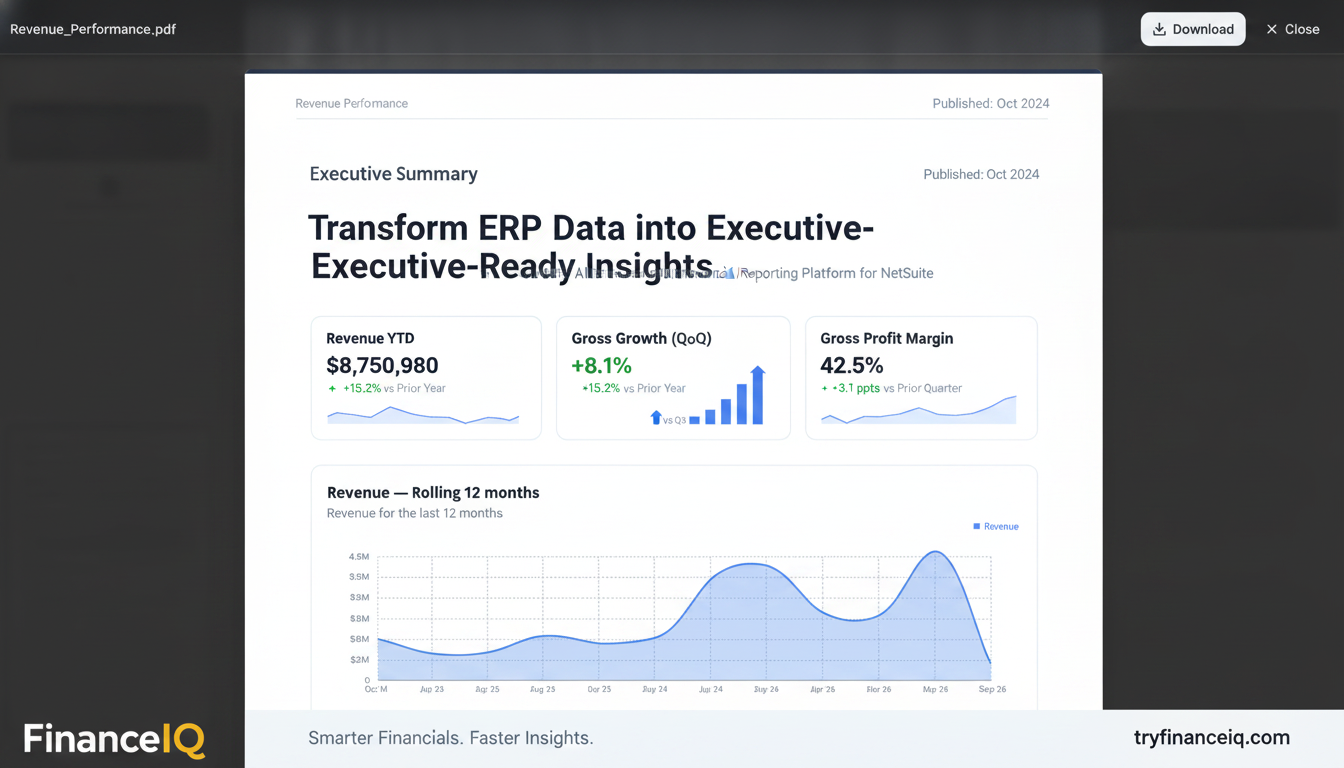
Addressing the challenge of consolidating and distributing insights effectively to stakeholders who may not log directly into NetSuite, FinanceIQ provides professional, executive-ready Reports. This image demonstrates how a FinanceIQ Report can present a professional, consolidated view of financial performance. Easily exported to PDF, such a report delivers a clear summary with multi-entity metrics.
How does NetSuite handle cumulative translation adjustment on consolidated balance sheets?
NetSuite handles cumulative translation adjustment (CTA) as part of its multi-currency consolidation process. When foreign subsidiary financial statements are translated into the parent's reporting currency, balance sheet accounts are typically translated at the current exchange rate, while equity accounts are translated at historical rates. The difference arising from these various translation rates, ensuring the consolidated balance sheet balances, is recorded as the Cumulative Translation Adjustment within the equity section. This ensures that assets equal liabilities plus equity after translation, accounting for the impact of exchange rate fluctuations on the net investment in foreign operations.
What causes multi-currency reconciliation variances during month-end?
Multi-currency reconciliation variances during month-end in NetSuite can stem from several sources. Common culprits include incorrect or inconsistent exchange rates being applied across different transactions or periods, timing differences in when exchange rates are updated or revaluations are run, unposted foreign currency journals, or manual adjustments made outside the system. Additionally, errors in intercompany transactions recorded in different currencies that are not properly eliminated can lead to reconciliation discrepancies. Thorough review of exchange rate tables and revaluation reports is essential to pinpoint the cause.
How can executive stakeholders review multi-entity performance without logging into NetSuite?
Executive stakeholders often need to review netsuite multi company setup performance without direct NetSuite access. Traditionally, this involves exporting reports to Excel or PDF, which can be static and quickly outdated. FinanceIQ provides a modern alternative through Boards and Reports that can be shared via public or private read-only links. These shared links offer live, up-to-date data, dashboards, and management reports, allowing executives to view consolidated financial statements, KPIs, and trends across all entities on any device without logging into the NetSuite instance itself. This streamlines distribution and ensures everyone is working from the same real-time data.
Conclusion
Managing netsuite global financial reporting across multiple subsidiaries is a critical, yet often challenging, responsibility for finance teams. While NetSuite OneWorld provides a robust foundation, the demands of performance, flexibility, and executive-level insight can quickly outpace native capabilities. By understanding OneWorld's architecture, leveraging best practices, and recognizing common limitations, finance professionals can improve their multi-entity reporting processes.
To move beyond the limitations and truly streamline your NetSuite consolidation challenges, consider how FinanceIQ can transform your multi-subsidiary reporting. Experience instant, live consolidation, flexible multi-entity dashboards, and AI-powered insights tailored to your NetSuite data. A simple per-instance subscription model, with a free trial available, makes it easy to see these numbers on your own NetSuite instance. Visit tryfinanceiq.com to learn more.