Navigating AI for NetSuite Finance Teams: A CFO's Guide to Secure, Actionable Insights with FinanceIQ's Finley.
AI is transforming finance, but CFOs need to discern hype from practical value, especially within NetSuite environments. This guide explores how to leverage AI securely for financial reporting and analysis, avoiding common pitfalls like data privacy risks and numerical hallucinations.
- AI for NetSuite
- NetSuite AI Strategy
- Financial Reporting
- FP&A
- CFO Insights
- Generative AI
- Finley AI
- Smart Finance Automation
The rapid ascent of Artificial Intelligence (AI) and Machine Learning (ML) has brought a wave of change across every industry, and enterprise finance is no exception. For CFOs, controllers, and finance leaders, the challenge isn't whether to adopt AI, but how to do so strategically, securely, and with genuine impact on their NetSuite financial operations. Separating true efficiency gains from marketing buzzwords is critical.
Every enterprise software vendor is racing to add “AI” to their platforms. This creates a complex landscape for finance teams reliant on NetSuite, who must sift through broad claims to find tools that deliver concrete value without introducing new risks or disrupting their core financial processes.
The State of AI in Enterprise Finance: Beyond the Hype.
Artificial intelligence is already making genuine contributions in specific areas of enterprise finance. These are typically tasks that are repetitive, pattern-based, or involve processing large volumes of structured data. Areas where AI and machine learning genuinely help today include:
- Anomaly Detection: AI algorithms can quickly flag unusual transactions, spending spikes, or deviations from historical trends in expense reports, payment runs, or revenue streams. This helps finance teams identify potential fraud or errors far faster than manual review.
- Recurring Transaction Coding and Categorization: Machine learning models can learn from past data to automatically code and categorize incoming transactions, reducing manual data entry for accounts payable and receivable, especially for high-volume, repetitive items.
- Rules-Based Automation: For processes governed by clear, consistent rules, AI-powered automation can streamline workflows. This might involve automatically routing invoices for approval or initiating payments based on predefined conditions.
- Predictive Analytics: Beyond simple forecasting, AI can analyze complex datasets to predict future financial outcomes, such as cash flow fluctuations or revenue trends, with greater accuracy by identifying subtle correlations human analysts might miss.
However, early AI tools often fall short when it comes to complex, nuanced financial analysis that requires deep contextual understanding, especially when data is spread across various systems or requires qualitative judgment. Generic AI chatbots, for example, often lack the specific financial domain knowledge and integration necessary to provide truly actionable insights grounded in a company's unique financial data.
What NetSuite Offers and Where External AI Fits.
NetSuite, as a comprehensive Enterprise Resource Planning (ERP) system, offers robust native capabilities for financial management, reporting, and automation. Tools like SuiteAnalytics Workbook provide powerful self-service reporting and analysis, allowing finance professionals to explore data and create visualizations. Similarly, the Financial Report Builder enables the creation of customizable financial statements.
NetSuite also incorporates forms of automation and intelligence within its core operations, such as intelligent search enhancements in SuiteAnswers for technical support. These features streamline operations and improve user experience within the platform itself.
However, there's an architectural gap between these native ERP automation capabilities and the need for secure, context-aware AI assistants that can deliver CFO-style insights. General-purpose Large Language Models (LLMs) are designed for broad knowledge and language generation, but they are not inherently equipped to securely process and interpret a company's sensitive general ledger (GL) data, nor are they typically trained on the intricacies of a specific NetSuite instance.
This is where external AI solutions, specifically designed for financial intelligence and NetSuite integration, play a critical role. They bridge the gap by providing a layer of intelligent analysis and natural language interaction that directly leverages your NetSuite data, going beyond what general-purpose AI or standard ERP reporting tools can offer.
The Three Major Risks of Deploying AI in Finance.
Deploying AI in finance, particularly with sensitive NetSuite data, comes with significant risks that CFOs must understand and mitigate.
1. Data Security and Privacy Vulnerabilities.
One of the most pressing concerns is the security and privacy of sensitive financial data. Sending general ledger data, customer information, or detailed expense reports to public AI models for training or processing introduces substantial risks. These models may inadvertently store or learn from your proprietary data, leading to:
- Data Leakage: Unintentional exposure of confidential financial figures or strategic plans.
- Competitive Disadvantage: Your data could indirectly inform models used by competitors.
- Regulatory Non-Compliance: Violations of data protection regulations like GDPR or CCPA if sensitive data is not handled with appropriate controls.
For finance teams, ensuring that AI tools operate within isolated, secure environments that do not contribute to public training sets is paramount. Any solution must explicitly guarantee data isolation and robust security protocols.
2. Hallucination Risks in Numerical Reporting.
Generative AI models, while powerful, are known to “hallucinate” – generating plausible but factually incorrect information. In financial reporting, a hallucination isn't just a minor error; it can lead to catastrophic misinterpretations, flawed strategic decisions, or even regulatory penalties.
An AI assistant providing an incorrect revenue figure, a misleading profit margin, or an entirely fabricated expense category could undermine trust and create significant operational problems. This risk is amplified when the AI isn't directly and verifiably grounded in the source-of-truth transactional data.
3. Lack of Direct Cross-Table Transactional Grounding.
Financial analysis often requires intricate aggregation and cross-referencing across various tables and segments within an ERP system – balancing multiple Dimensions like department, class, location, and subsidiary. Generic AI tools often struggle with this level of specific transactional grounding.
They may summarize high-level data but fail to drill down to the exact general ledger accounts or individual transactions that compose a financial figure. Without this direct link, the AI cannot provide precise, auditable answers to “why” questions, making its insights less reliable for a finance professional who needs to understand the root cause of variances or trends.
What Practical AI Looks Like for Mid-Market FP&A.
For mid-market finance teams, practical AI isn't about replacing human judgment but augmenting it with speed, accuracy, and depth. It means AI that works with the CFO and FP&A team, not in isolation. Here’s what practical, secure AI looks like in a NetSuite environment:
- Natural Language Querying of Live Financial Models: Imagine asking, “Show me our gross margin trend by product line for the last four quarters” and getting an instant, accurate chart or table directly from your NetSuite data, without manual report building or complex SQL queries.
- Instant Variance Commentary Drafts: After a month-end close, AI could analyze key variances in your financial statements (P&L, balance sheet, cash flow) and draft preliminary commentary, highlighting significant deviations and potential drivers based on your underlying data. This significantly speeds up board report preparation.
- Automated Preliminary Trend Analysis: AI can proactively identify emerging financial trends, outliers, or anomalies in revenue, expenses, or cash flow and bring them to the finance team's attention, enabling earlier intervention and strategic planning.
- Secure Assistants Tethered Strictly to the Company's Source-of-Truth Database: The most crucial element is that the AI must be securely connected to and only respond with insights derived from your NetSuite instance. It must not learn from or contribute to public models, ensuring data privacy and accuracy.
This type of AI empowers finance teams to move from reactive data collection to proactive, strategic analysis, driving faster insights and better decision-making. To provide a clear example of these practical applications, the following illustration demonstrates a typical FinanceIQ dashboard, bringing together key financial metrics and trends in a single, intuitive view for rapid analysis.
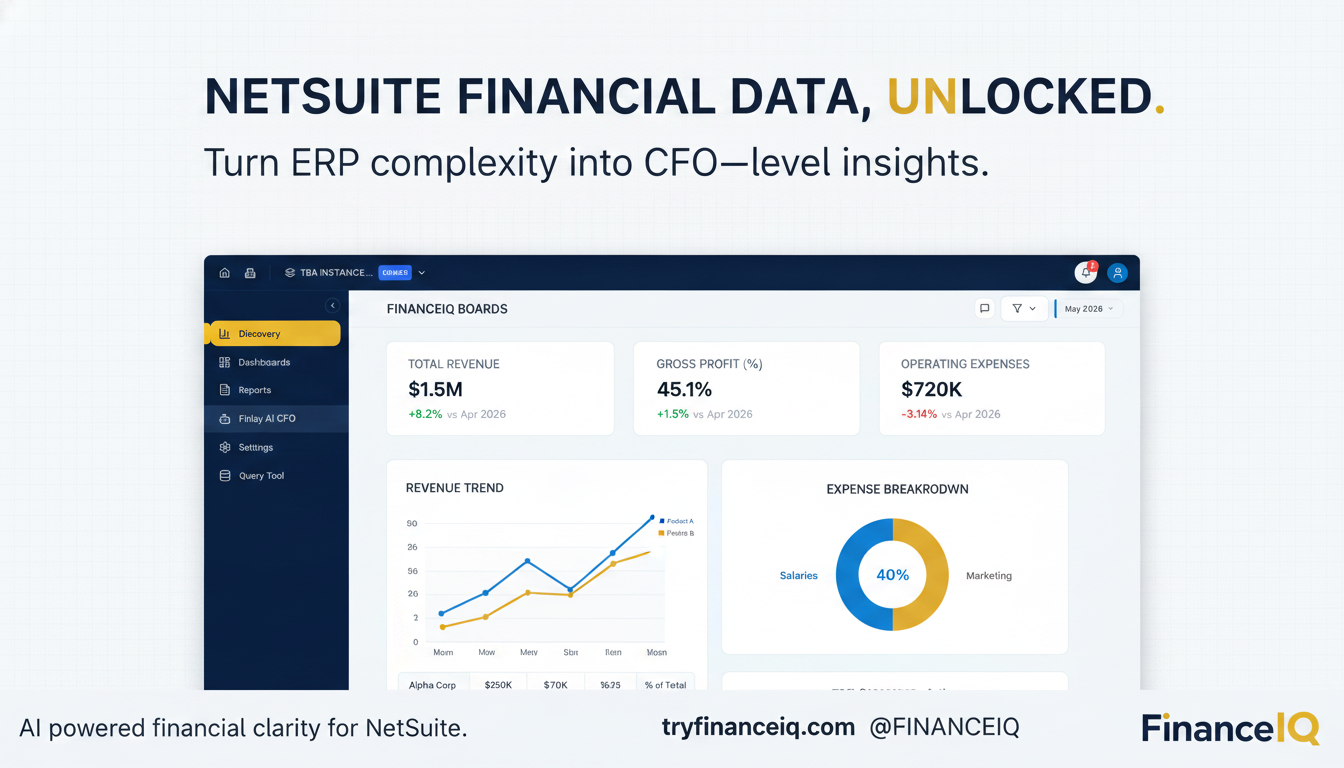
This integrated visual dashboard allows finance professionals to quickly grasp complex data, identify patterns, and focus on strategic actions.
FinanceIQ and Finley Redefine AI in NetSuite.
FinanceIQ is purpose-built to deliver this practical, secure AI experience directly within your NetSuite financial environment. It understands the unique requirements of NetSuite finance teams and integrates an intelligent layer that addresses the risks and delivers the capabilities discussed above.
FinanceIQ's AI financial assistant, Finley, operates on a secure, context-aware architecture. Unlike generic chatbots, Finley is tethered directly to your company's live NetSuite data. This means that when you ask Finley a question, it answers using your own numbers – your specific accounts, classes, departments, and financial data – ensuring that insights are grounded, accurate, and relevant to your operations. This architecture inherently protects sensitive general ledger data from being exposed to public AI training sets.
Finley bridges the gap between static financial tables and plain-English narrative exploration. You can ask complex operational questions, such as “Why did marketing spend deviate from plan in EMEA last month?” or “What are our top 5 expenses by department this quarter?”, and Finley will provide grounded financial insights based on your actual NetSuite data. This capability extends to FinanceIQ’s core features, enhancing how finance leaders interact with their Boards (customizable dashboards), Reports (block-based management reports), live financial statements (P&L, balance sheet, cash flow), and KPI cards.
With FinanceIQ, setup is fast, often taking minutes rather than weeks or months, as it connects natively to NetSuite without requiring a separate data warehouse or complex IT projects. This eliminates the need for manual spreadsheet work, re-keying data, or stitching together disparate SuiteAnalytics exports. FinanceIQ provides a single, unified view of your financial performance, powered by AI, directly from your NetSuite instance. To further clarify how this secure, dedicated data flow operates, the following architectural diagram illustrates the journey of your NetSuite data through FinanceIQ's private AI processing layer to Finley's actionable insights.
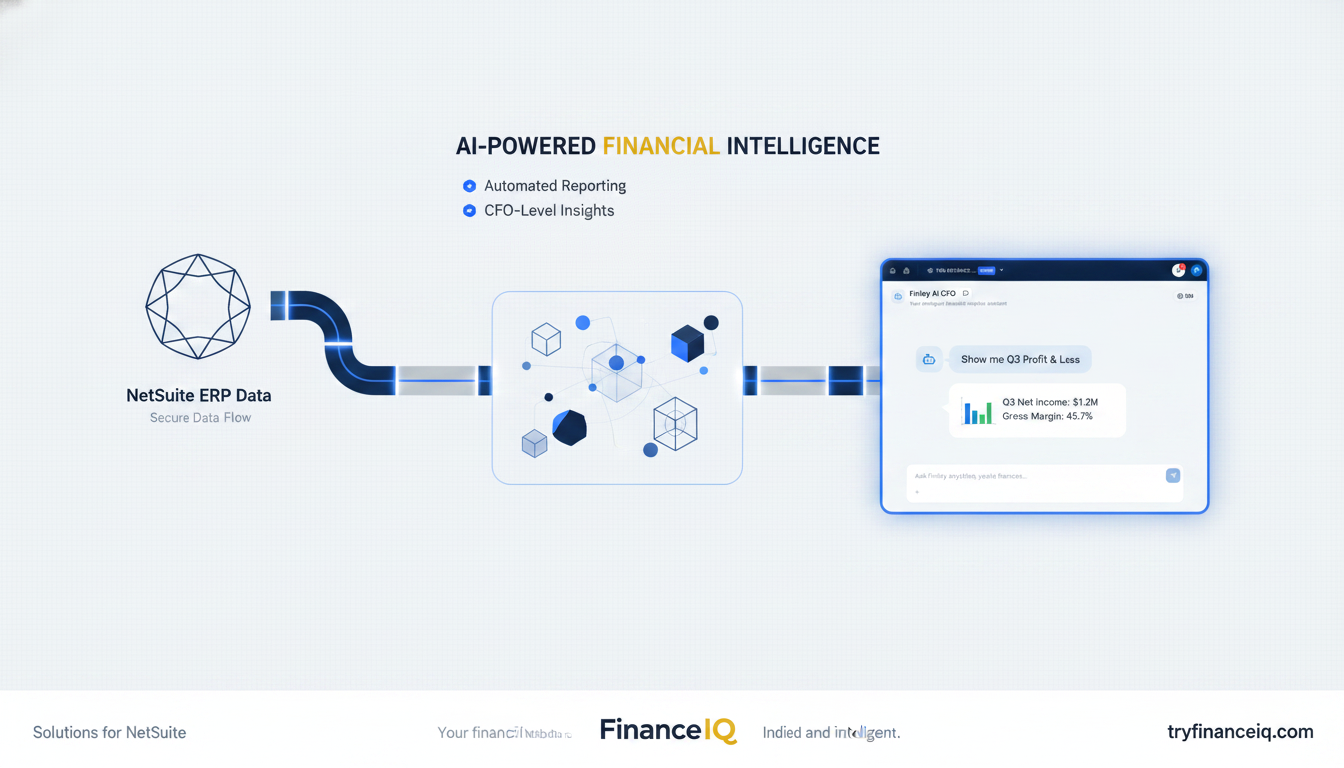
This visual demonstrates the secure and isolated environment that ensures your financial data remains private and protected.
A CFO’s Framework for Evaluating Financial AI.
Evaluating and deploying AI tools in an accounting and FP&A environment requires a disciplined approach. CFOs should consider this five-rule framework:
- Verify Data Isolation Boundaries: Explicitly confirm that the AI tool operates within a secure, private environment. Ensure sensitive financial data from your NetSuite instance will not be used to train public models or be accessible outside your organization.
- Demand Source-of-Truth Grounding: The AI must prove that its answers are directly derived from and traceable to your NetSuite’s source-of-truth data. Look for drill-down capabilities that allow you to verify the underlying transactions and accounts that form an AI-generated insight.
- Maintain Human-in-the-Loop Sign-Off: For all critical financial decisions, board materials, and external reports, human oversight and final sign-off are non-negotiable. AI should assist and accelerate, not autonomously decide. Ensure the tools facilitate, rather than hinder, this human review process.
- Test Accuracy on Edge-Case Variances: Don't just test AI on typical scenarios. Challenge it with unusual financial variances, complex intercompany transactions, or unique departmental allocations (Dimensions). Assess its ability to provide accurate and contextualized explanations in these edge cases.
- Assess Integration Latency and Setup: Evaluate how quickly and easily the AI solution integrates with NetSuite. A long, complex IT project undermines the promise of efficiency. Prioritize solutions with fast, native connections that leverage your existing NetSuite configuration without extensive custom development or data migration.
Frequently Asked Questions About AI in NetSuite Finance.
How can CFOs safely evaluate AI tools for NetSuite environments?
CFOs should prioritize solutions that offer secure, direct integration with NetSuite, guarantee data privacy (no public model training), and provide transparent, auditable insights. Focus on tools that clearly articulate their data governance policies and allow you to verify the source of all AI-generated financial figures.
What is the difference between a general-purpose chatbot and a finance-specific AI assistant like Finley?
A general-purpose chatbot is trained on vast public datasets and offers broad conversational abilities but lacks specific financial domain knowledge and access to proprietary company data. A finance-specific AI assistant like Finley, on the other hand, is designed to understand financial concepts and is securely connected to your NetSuite instance, providing insights directly from your company's own general ledger and reporting Dimensions.
How does FinanceIQ protect sensitive general ledger data from public AI training?
FinanceIQ's architecture is built for data isolation. It connects natively and securely to your NetSuite instance, and Finley processes your data within this private, dedicated environment. Your sensitive general ledger data is never used to train public AI models, ensuring confidentiality and security.
Can AI assistants automatically draft monthly variance commentary for board decks?
Yes, a well-designed finance-specific AI assistant can analyze key financial variances across your P&L, balance sheet, and cash flow statements, then generate preliminary drafts of commentary. This significantly accelerates the process of preparing management and board reports by providing context-aware narrative based on your live NetSuite numbers.
How do I ensure my financial AI assistant isn't hallucinating numbers?
To prevent hallucination, your AI assistant must be strictly grounded in your NetSuite's source-of-truth data. Solutions like FinanceIQ’s Finley allow for drill-down capabilities, so you can always trace any AI-generated insight back to the specific live financial statements, KPIs, or underlying transactions in your NetSuite instance, ensuring accuracy and auditability.
What technical setup is required to bring an AI layer like Finley into a NetSuite-backed organization?
Integrating FinanceIQ and Finley into a NetSuite-backed organization is designed for rapid deployment. It connects natively to your NetSuite instance, typically requiring minutes to set up. There's no need for complex IT projects, separate data warehouses, or extensive custom coding. The process leverages NetSuite's existing data structure to provide immediate access to your financial information.
The Future of Finance is Intelligent and Secure.
The future of finance with NetSuite is not just about automation, but about intelligent, secure insights. FinanceIQ, with Finley, transforms raw NetSuite data into actionable intelligence, empowering CFOs and finance teams to make faster, more informed decisions. It’s about leveraging the power of AI to gain deep, contextual understanding of your financial performance, without compromising security or accuracy.
Ready to see your NetSuite data through an intelligent lens? Explore how FinanceIQ can transform your financial reporting and analysis. A simple per-instance subscription model includes a free trial on your first instance, allowing you to experience the power of Finley and live financial insights with your own numbers. Visit tryfinanceiq.com to learn more.