AI in NetSuite Finance: Natural Language Querying Transforms FP&A
Modern finance teams leveraging NetSuite face a critical challenge: rapidly extracting precise answers from complex ERP data. This post explores how artificial intelligence and natural language querying are fundamentally changing financial planning and analysis, enabling CFOs, controllers, and FP&A teams to gain insights faster and more effectively.
- NetSuite
- AI
- Artificial Intelligence
- Financial Reporting
- FP&A
- Natural Language Processing
- Conversational Finance
- NetSuite Data Analytics
- CFO Insights
For many finance leaders running on NetSuite, the quest for a simple, immediate answer often leads down a winding path. A CEO asks, "Why did software hosting expenses spike last month?" or "What's our gross margin trend across subsidiaries?" The answer, historically, involves navigating nested NetSuite reports, crafting intricate saved searches, or exporting data to spreadsheets for manual pivot tables. This traditional approach consumes valuable time, creates bottlenecks, and delays critical business decisions.
The promise of artificial intelligence (AI) in finance is to dissolve these bottlenecks, allowing finance professionals to converse with their NetSuite data as naturally as they would with a colleague. This shift from manual data extraction to conversational analytics represents a profound evolution for financial planning and analysis (FP&A) and accounting operations.
The Evolution of Finance Tooling: From Manual Ledgers to Cloud Platforms
Finance tools have undergone continuous transformation. Centuries ago, ledgers were physical books, meticulously maintained by hand. The advent of spreadsheets revolutionized financial modeling and analysis, offering unprecedented flexibility and calculation power. While a massive leap forward, spreadsheets still require manual data input and complex formula management, often leading to errors and version control issues.
With the rise of enterprise resource planning (ERP) systems like NetSuite, financial data became centralized, enabling better integration across business functions. Cloud-based platforms further enhanced accessibility and collaboration. Yet, even with these advancements, extracting nuanced, ad-hoc insights from vast datasets often remained a manual, labor-intensive process, demanding technical proficiency in report builders or specialized database querying languages. The next frontier in this evolution is the seamless integration of AI, moving finance from data aggregation to intelligent, on-demand insight generation.
What NetSuite Offers Natively for Automated Insights
NetSuite, as a powerful cloud ERP, provides a robust set of native tools for financial reporting and analysis. These include:
- Standard Reports: Pre-built financial statements like the Income Statement (P&L), Balance Sheet, and Cash Flow, along with various operational reports. While comprehensive, they are often static and require customization to answer specific, ad-hoc questions.
- Financial Report Builder: This tool allows users to create custom financial layouts by dragging and dropping accounts and segments. It offers flexibility for structured reporting but still demands a clear understanding of report logic and configuration.
- Saved Searches: A highly versatile feature in NetSuite, saved searches enable users to define specific criteria to extract and analyze transactional data. They are powerful for detailed data mining but require users to specify conditions, filters, and result columns precisely, making them less intuitive for quick, plain-English queries.
- SuiteAnalytics Workbooks and Dashboards: These tools allow for more interactive data visualization and analysis, building on saved searches to create charts and tables. Dashboards can display key performance indicators (KPIs) and summaries. While valuable for monitoring trends, they still rely on pre-defined structures and often lack true conversational or natural language reasoning capabilities.
While these native NetSuite tools are essential for managing financial operations and structured reporting, they generally fall short when finance teams need immediate, conversational answers to complex, unstructured questions without manual configuration or technical expertise. They provide the data, but not always the direct, AI-powered conversation with that data that modern finance leaders seek.
Common Pain Points with Traditional Data Retrieval
The reliance on traditional NetSuite data retrieval methods, while functional, introduces several common pain points for finance and accounting teams:
Time-Consuming Ad-Hoc Reporting
Responding to one-off questions from leadership can consume hours, or even days. A request like "Show me the revenue contribution by product line for the last three quarters, excluding returns, and compare it to the previous year" might require creating a new saved search, exporting the data, manipulating it in a spreadsheet, and then summarizing the findings. This iterative process is slow and inefficient.
Dependency on Technical Expertise
Creating complex saved searches or advanced SuiteAnalytics Workbooks often requires a deeper understanding of NetSuite's data model and query language. This can lead to a bottleneck where finance teams depend on NetSuite administrators or IT personnel to generate the necessary data, slowing down the entire analytical process.
Data Export Risks and Inconsistencies
Exporting sensitive financial data to external tools for analysis introduces security and compliance risks. Furthermore, manual data manipulation outside of NetSuite increases the potential for errors and inconsistencies, making it difficult to ensure a single source of truth. Each new export creates a potential for divergence from the live NetSuite data.
Lack of Contextual Insights
Traditional reports and searches present raw data. Extracting genuine insights—understanding why numbers changed or what implications a trend holds—still largely depends on the finance professional's analytical skill and experience. The tools don't inherently provide the qualitative explanations that often accompany quantitative shifts.
To illustrate the depth of analysis required, consider a complex financial movement like cash flow. Understanding the precise drivers behind changes in operating cash flow often involves meticulously piecing together multiple reports and transactions, a process greatly accelerated by AI. The following visualization provides a detailed cash flow waterfall, offering a comprehensive breakdown of cash movements.
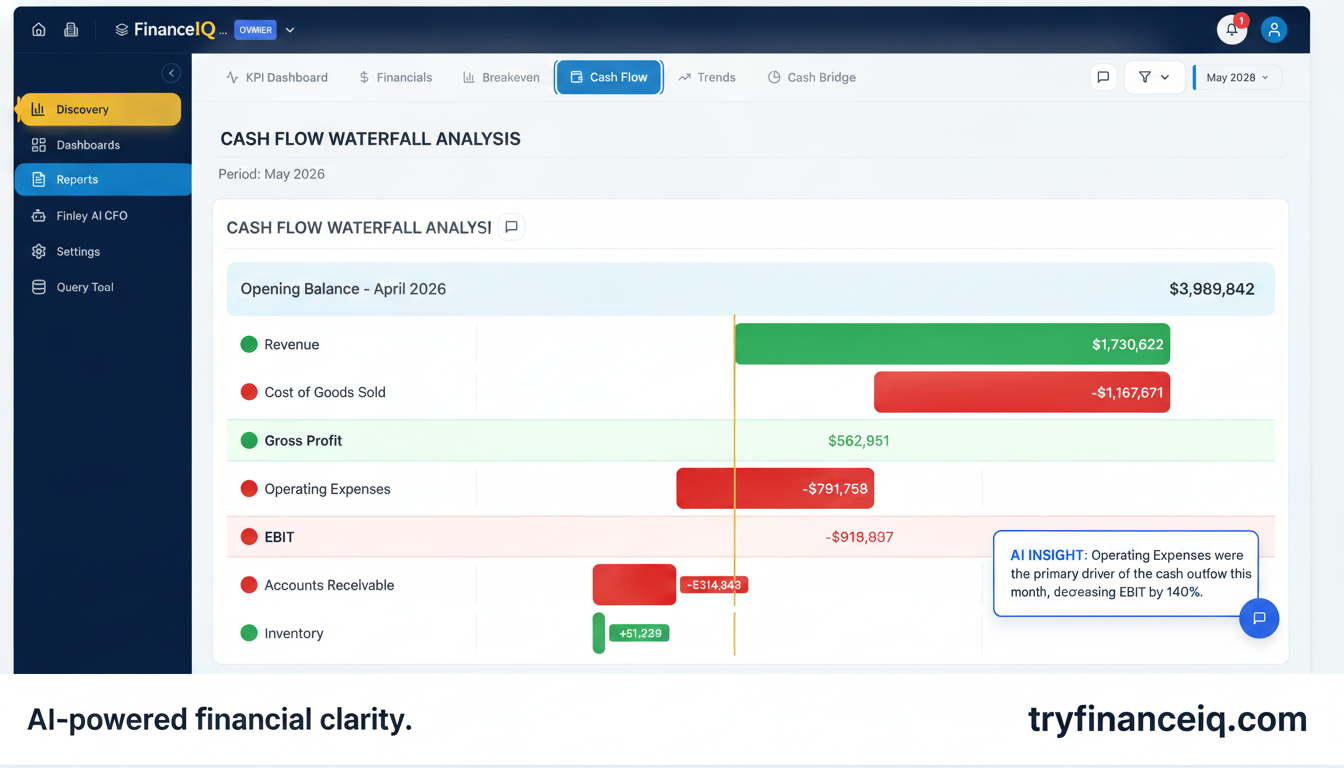
Finance teams often grapple with detailed financial visualizations, such as this cash flow waterfall. An AI assistant can help distill the complex movements into actionable insights, explaining the 'why' behind the numbers.
These challenges highlight a clear need for more intuitive, immediate, and intelligent ways to interact with NetSuite financial data—a need that artificial intelligence is now poised to address.
The Rise of Conversational Finance and AI Assistants
The emergence of powerful language models and generative AI has ushered in an era of "conversational finance." This new paradigm allows finance professionals to move beyond rigid reporting structures and interact with their enterprise data systems using plain English. Instead of building queries or reports, users can simply ask questions, and the AI assistant retrieves, analyzes, and presents the relevant financial information.
Conversational finance tools are designed to securely connect directly to your company's financial data, providing a layer of intelligent interpretation. They leverage natural language processing (NLP) to understand the intent behind a user's question, even if phrased casually. This means an FP&A analyst can ask "What's the variance in marketing spend by department compared to last quarter?" and receive a direct, data-backed answer, often accompanied by context and explanations.
Key benefits of this approach include:
- Instant Answers: Significantly reduces the time spent on ad-hoc analysis.
- Democratized Access: Empowers non-technical finance users to independently explore data.
- Deeper Insights: AI can identify patterns and anomalies that might be missed in manual review.
- Enhanced Productivity: Frees up finance teams from repetitive data extraction tasks to focus on strategic analysis.
This shift isn't just about speed; it's about fundamentally changing how finance teams interact with their data, making insights more accessible and actionable. The capacity to quickly generate structured, comprehensive reports, often refined by AI-driven insights, empowers teams to deliver clear narratives to stakeholders, ensuring a shared understanding of the financial landscape. This example demonstrates a polished revenue performance report, a final output that benefits from accelerated initial data exploration and clarity.
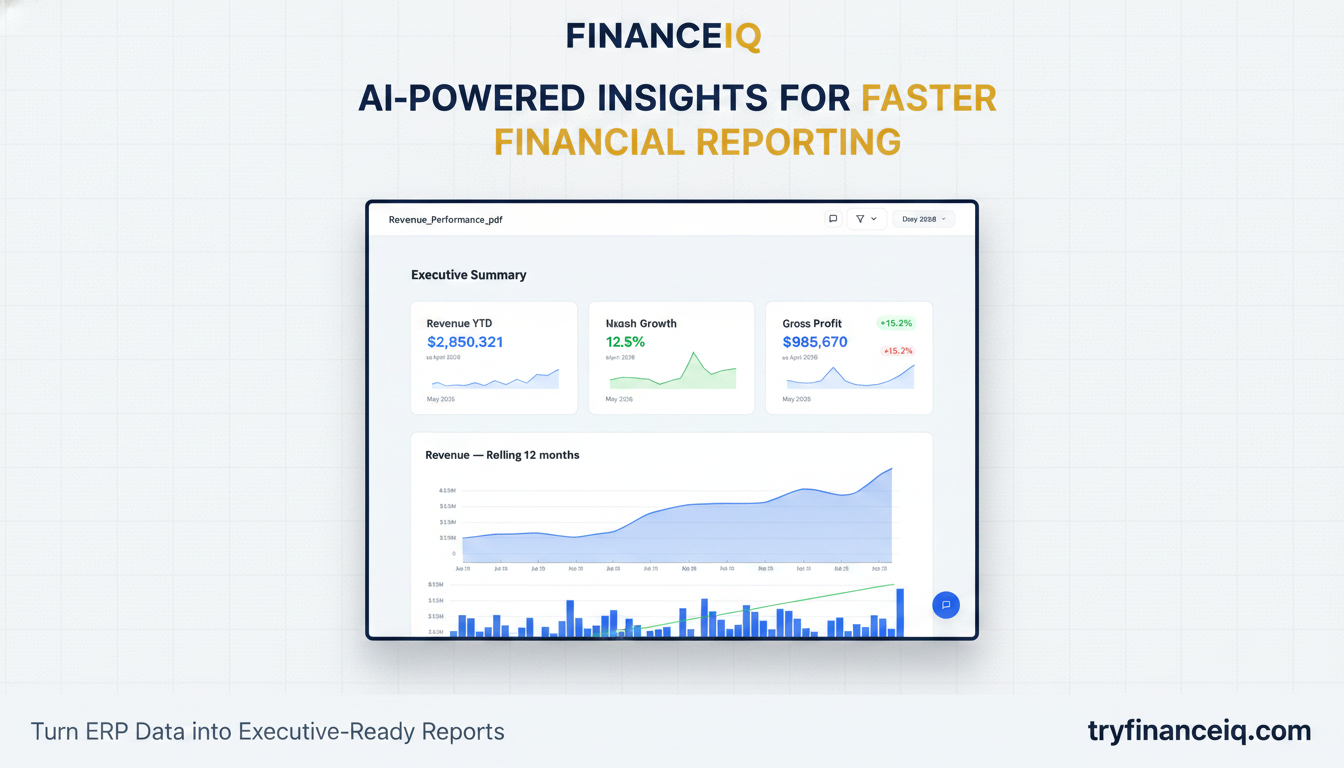
Structured financial reports, like this Revenue Performance PDF, are often the culmination of deep data dives and analyses. Conversational AI can accelerate the initial exploration and refinement of these insights, ensuring that the final output is comprehensive and clearly articulated for executive review.
How FinanceIQ and Finley Bring AI to NetSuite
FinanceIQ directly addresses the challenges of traditional NetSuite financial reporting by integrating AI-powered capabilities designed specifically for finance leaders. Central to this is Finley, FinanceIQ's AI financial assistant, which transforms how NetSuite teams interact with their financial data.
Finley is not a generic chatbot; it is a context-aware AI advisor grounded in your company's own numbers from NetSuite. This means when you ask Finley a question, it understands your specific accounts, classes, departments, and financial data structure. This capability directly tackles the ad-hoc reporting friction faced by NetSuite users. Instead of navigating complex menus or building saved searches, an instance owner or editor can simply ask Finley in plain English for insights into P&L variances, burn rates, departmental spend, or any other financial metric.
For example, if you need to understand "Why did software hosting expenses spike last month?" (the very question that starts this post), Finley can analyze your live NetSuite data, identify the contributing factors, and present a concise explanation. This natural language querying capability extends across all your financial statements and reporting dimensions, providing granular insights without requiring technical report-building skills.
Crucially, FinanceIQ maintains strict data privacy and security. Your company's sensitive financial data is never used to train public language models or sent to external AI tools with inherent compliance risks. Finley operates within a secure environment, ensuring that all financial insights are derived from and remain within your NetSuite instance's connected data, safeguarding your confidential information. The platform is designed to combine quantitative financial tables and charts with plain-English qualitative explanations, providing a holistic view that empowers faster, more informed decision-making.
To truly appreciate the power of conversational finance, consider Finley in action. Here, we see its intuitive interface, demonstrating how users can engage with their NetSuite financial data using natural language, receiving instant, context-aware answers to complex queries.
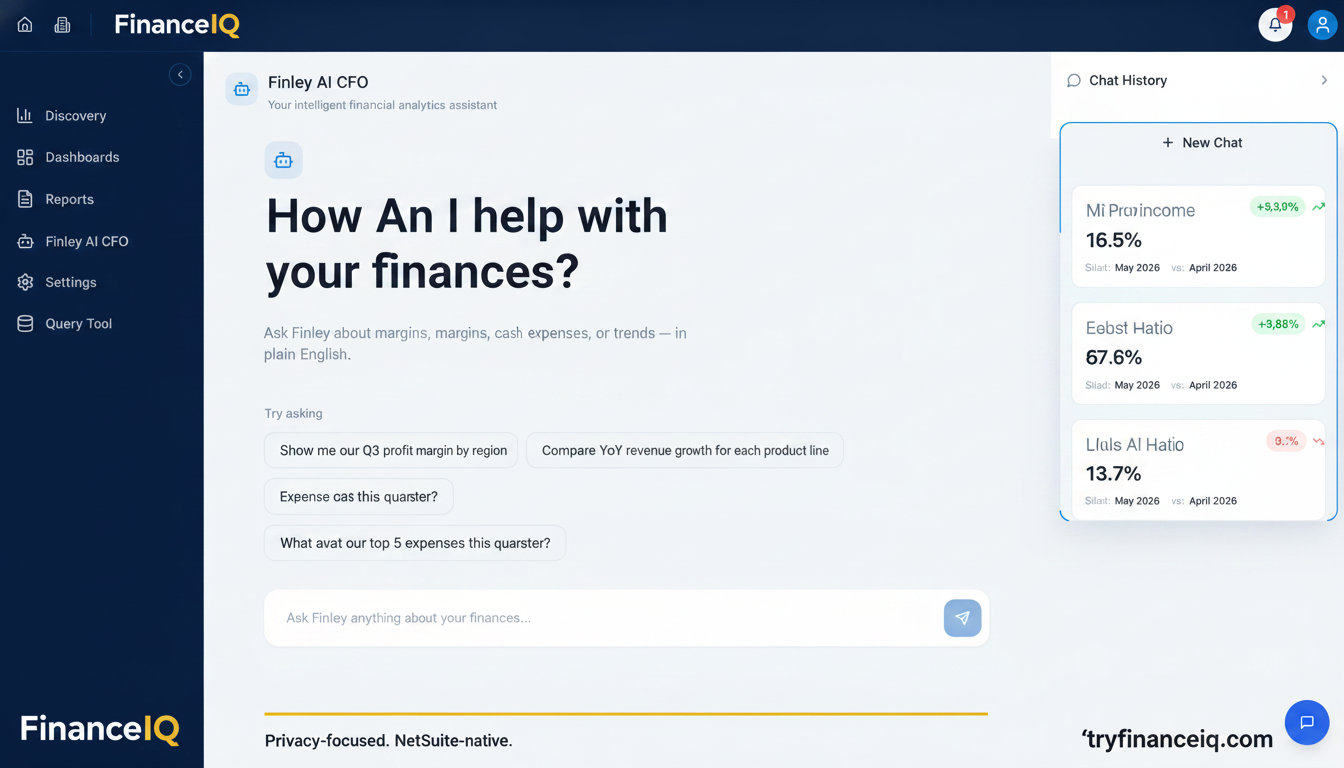
Finley, FinanceIQ's AI financial advisor, allows users to ask complex financial questions using natural language. This interface demonstrates how you can query your NetSuite data for insights into trends, variances, and specific accounts, receiving immediate, context-aware answers directly within the platform.
By leveraging Finley, FinanceIQ empowers CFOs, controllers, and FP&A teams to bypass manual data extraction and lengthy analysis cycles. The result is rapid, accurate, and insightful financial reporting that truly leverages the power of artificial intelligence, without compromising security or requiring extensive technical resources. This brings artificial intelligence in NetSuite to the forefront of netsuite ai accounting and ai powered financial reporting netsuite efforts.
Best Practices for Adopting AI in Finance
Integrating conversational analytics and AI assistants like Finley into finance and accounting workflows requires a thoughtful approach. To maximize benefits while maintaining accuracy and compliance, consider these five best practices:
1. Maintain Source-of-Truth Validation
Always ensure that the AI assistant is drawing data directly from your authoritative source, which for NetSuite users means your NetSuite instance. FinanceIQ connects natively to NetSuite, eliminating the need for data exports or parallel books. Regularly validate AI-generated insights against core financial statements and transactional data to build trust and ensure accuracy, especially in the initial stages of adoption. The AI should serve as an accelerator, not a replacement for fundamental financial principles.
2. Implement Human-in-the-Loop Review for Board Materials
While AI can generate powerful insights and commentary, human oversight remains critical, particularly for board presentations and external reporting. AI assistants excel at identifying trends and drafting preliminary analysis, but a finance professional should always review, refine, and contextualize these outputs before they reach executive teams or external stakeholders. This ensures the narrative aligns with strategic goals and nuanced business understanding.
3. Ensure Robust Data Privacy Compliance
When adopting generative AI in FP&A, data privacy and security must be paramount. Verify that the AI solution processes your financial data securely and does not use it for public model training. FinanceIQ's Finley is designed with this in mind, processing data within a secure environment connected to your NetSuite instance without sharing sensitive information externally. Understand the data governance policies of any AI tool you consider to ensure compliance with internal policies and external regulations.
4. Clearly Scope Ad-Hoc Queries and Use Cases
Start by identifying specific pain points and common ad-hoc queries that frequently bog down your team. Begin integrating AI for these well-defined use cases, such as analyzing P&L variances, tracking departmental expenses, or calculating burn rates. This focused approach allows your team to gain proficiency and demonstrate tangible value quickly, building confidence before expanding to more complex applications.
5. Train Teams on Effective Prompt Design
The quality of AI-generated insights often depends on the clarity and specificity of the user's prompts. Invest in training your finance team on how to formulate effective questions for the AI assistant. Teach them to be precise, provide context, and iterate on their queries. Understanding how to interact with netsuite natural language querying tools empowers users to extract the most valuable insights and fully leverage netsuite chat with your data capabilities.
By following these best practices, finance teams can safely and effectively integrate netsuite ai finance capabilities, transforming their operations and elevating their strategic impact. This strategic adoption will allow netsuite automation and ai to streamline workflows and deliver enhanced insights.
Frequently Asked Questions About AI in NetSuite Finance
Can NetSuite answer natural language questions about my financials?
Natively, NetSuite provides powerful reporting and analytics tools like Saved Searches and SuiteAnalytics Workbooks, but these require users to build queries using specific criteria and field selections. They do not offer true natural language querying where you can simply ask a question in plain English and receive a direct answer from your live financial data. Specialized AI solutions built for NetSuite, like FinanceIQ's Finley, provide this conversational capability.
How does an AI financial assistant safely connect to NetSuite data?
A secure AI financial assistant connects to NetSuite data through native integration, typically leveraging NetSuite's robust authentication mechanisms (like OAuth). This ensures that data remains secure and is accessed only with authorized credentials. FinanceIQ, for example, connects directly to your NetSuite instance to sync financial data, maintaining a secure link without requiring data exports to third-party environments.
What is the difference between a custom saved search and asking an AI assistant a financial question?
A custom saved search in NetSuite requires you to define specific criteria, filters, and result columns. It's a structured query language. Asking an AI assistant a financial question, by contrast, involves using everyday language. The AI interprets your question, translates it into the necessary data queries, and presents the answer in an easily understandable format, often with additional context or analysis, without you needing to know the underlying data structure or query syntax. An ai financial analyst for netsuite can interpret intent.
How do I ensure data privacy and security when using AI for FP&A?
To ensure data privacy and security, choose an AI solution that explicitly states it does not use your financial data for public model training. The solution should operate within a secure, private environment connected directly to your ERP, like NetSuite. This prevents your sensitive financial information from being exposed or used by broader, less secure AI systems. Always review the data governance policies of any AI tool.
Can an AI assistant generate variance commentary automatically?
Yes, advanced AI financial assistants can analyze financial variances (e.g., between actuals and prior periods, or actuals and forecasts) and generate qualitative commentary. By understanding your specific accounts and dimensions from NetSuite, the AI can identify the key drivers of a variance and provide a plain-English explanation, complementing the quantitative figures with actionable insights. This capability is a core benefit of conversational finance netsuite solutions.
How can executive teams query live financial metrics without logging into NetSuite?
Executive teams can query live financial metrics without logging directly into NetSuite by using dedicated financial dashboards and reporting platforms that integrate with NetSuite. Solutions like FinanceIQ allow for the creation of customized Boards and Reports that can be shared via secure links. These platforms provide a user-friendly interface for accessing KPIs, charts, and financial statements, often with drill-down capabilities, and can be further enhanced by AI assistants like Finley for on-demand answers without needing deep NetSuite knowledge.
Transform Your NetSuite Finance Operations with AI
The integration of artificial intelligence into financial operations marks a pivotal moment for NetSuite users. By leveraging netsuite ai assistant capabilities, finance teams can move beyond reactive reporting to proactive, insight-driven decision-making. FinanceIQ, with its AI advisor Finley, allows you to query your NetSuite data in plain English, transforming complex financial analysis into a conversational experience. See these numbers on your own NetSuite data and discover how quickly you can gain profound insights. A free trial is available for your first instance. Visit tryfinanceiq.com/pricing to learn more about a simple per-instance subscription.